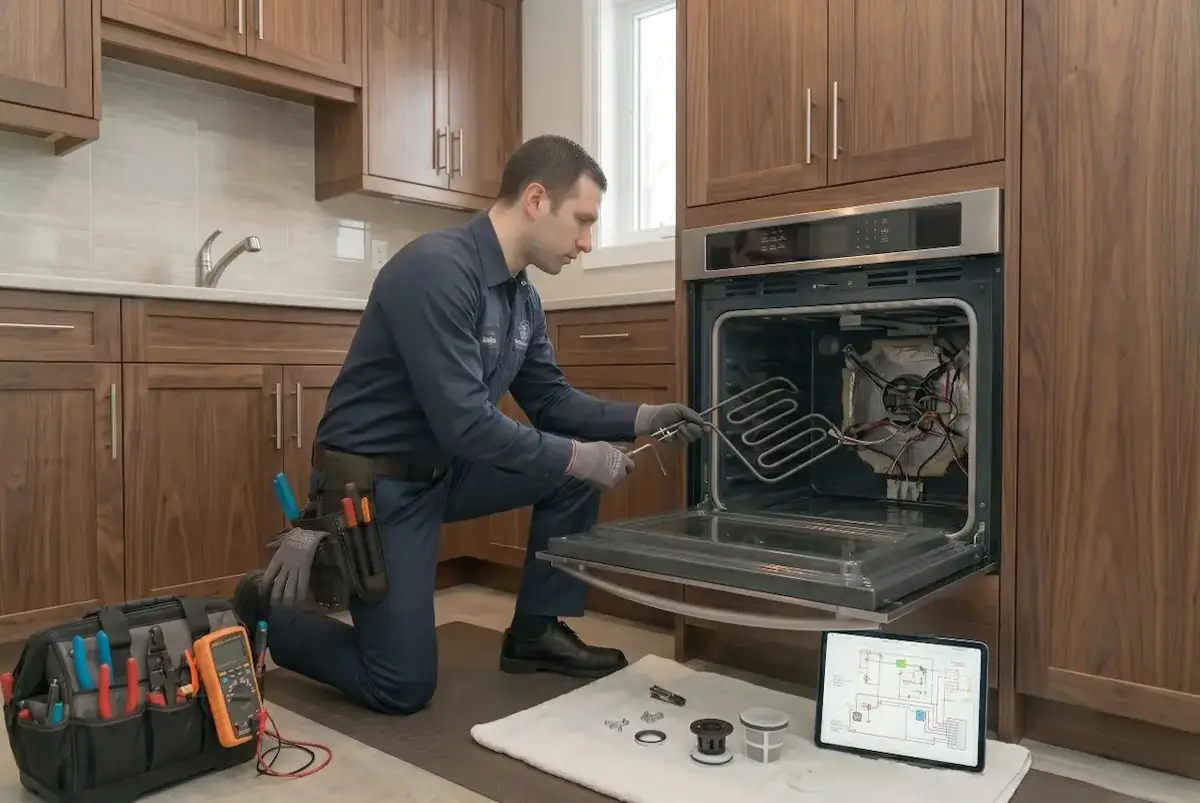
How much does Frigidaire wall oven repair cost in York?
Frigidaire wall oven repair in York typically runs $250–$560 all-in, depending on the fault. The most common Frigidaire call-out is oven not heating at all ($250–$420). Every visit starts with a flat $149.95 diagnostic, credited 100% toward your repair, and repairs are backed by a warranty.
- Diagnostic
- $149.95, credited 100% toward your repair
- Warranty
- on parts & workmanship
- Availability
- Same-day & next-day appointments available
Prices in CAD for York; typical ranges — your exact quote is confirmed on-site before any work. Updated .
Most Frigidaire wall oven faults in York come down to a handful of parts — and the majority are worth repairing rather than replacing a 13–15 years appliance. Anthony is a Red Seal certified technician who carries the common wall oven parts on the van, so most York jobs are diagnosed and fixed in a single visit.
Frigidaire Wall Oven repair costs in York
Honest, all-in ranges for common jobs. Every visit starts with a flat $149.95 diagnostic that is credited 100% toward your repair — so you never pay it twice.
| Problem | Parts | Labour | All-in |
|---|---|---|---|
| Oven not heating at all | $30–$190 | $130–$220 | $250–$420 |
| Not reaching or holding temperature (uneven baking) | $25–$200 | $130–$210 | $250–$430 |
| Gas oven won't ignite (igniter glows weakly) | $40–$180 | $140–$230 | $260–$430 |
| Oven temperature inaccurate | $25–$120 | $130–$200 | $250–$380 |
| Won't turn on / no display | $15–$320 | $130–$210 | $250–$520 |
| Self-clean won't start, or door locked after self-clean | $15–$180 | $130–$210 | $250–$400 |
| Broiler not working | $35–$160 | $130–$210 | $250–$400 |
| Control board / touchpad fault | $80–$360 | $130–$210 | $280–$560 |
| Diagnostic (credited to the repair) | $149.95 |
Ranges are estimates for common York jobs; your exact quote is confirmed on-site before any work begins. Prices in CAD, updated .
How your repair works
Four simple steps, no surprises.
Book
Call or request a callback. Same-day & next-day appointments available.
Diagnose
A flat $149.95 diagnostic pinpoints the real fault.
Approve
You get an upfront all-in quote first — diagnostic credited 100% toward your repair.
Repaired
Fixed with OEM parts, backed by a 90-day warranty.
Common Frigidaire Wall Oven problems & what we check
Tap any problem for the likely causes, what is safe to check yourself, and what it costs.
Oven not heating at all
Oven not heating at all: The oven turns on and the display works, but the cavity stays cold — on an electric oven the bake element never glows orange; on a gas oven you may hear the gas valve but get no flame.
Also described as: oven won't heat, oven cold, stays cold, no heat, oven not getting hot
Likely causes
- Electric: failed (open/burned-out) bake element — often visibly blistered or severed (Most common (electric))
- Gas: weak hot-surface igniter that glows but no longer draws enough current to open the safety gas valve (Most common (gas))
- Failed oven temperature sensor (RTD/thermistor) or a control/relay board not switching power to the element/igniter (Common)
- Blown thermal fuse or tripped breaker cutting power to the heating circuit (Occasional)
✔ Safe to check yourself
- Confirm the oven isn't in a delay-start, Sabbath, or demo/showroom mode (check the manual to exit it).
- Check the breaker — a 240V electric oven runs on a double-pole breaker; if one leg trips the broil/bake can lose heat while the display still lights.
- On an electric oven, look through the door while it heats: a healthy bake element glows uniformly orange; dark, blistered, or broken sections confirm a dead element.
✖ Leave to a technician
- Do not test or replace a gas igniter or gas valve yourself — gas work is TSSA-certified-technician-only.
- Do not touch element terminals, the thermal fuse, or board wiring with the oven powered — 240V shock hazard; element swaps mean disconnecting power at the breaker.
Related: Not reaching or holding temperature (uneven baking) · Gas oven won't ignite (igniter glows weakly) · Won't turn on / no display
Not reaching or holding temperature (uneven baking)
Not reaching or holding temperature (uneven baking): The oven heats but never quite reaches the set temperature, takes far too long to preheat, or bakes unevenly — one side or rack done, the other raw.
Also described as: oven not hot enough, takes forever to preheat, uneven baking, food undercooked, temperature drops
Likely causes
- Drifting or failing oven temperature sensor (RTD/thermistor) reading the cavity wrong (Most common)
- Partially failed bake or broil element — one element out so only half the heat is delivered (Common)
- Weak gas igniter that opens the valve slowly, lengthening preheat and causing temperature swings (Common (gas))
- Failed convection fan/element (convection models) or a control board mis-cycling the heat (Occasional)
✔ Safe to check yourself
- Verify with an independent oven thermometer placed centre-rack — confirm how far off the actual temperature is before assuming a fault.
- Make sure both racks aren't overcrowded and that you're fully preheating; blocked airflow alone causes uneven results.
- Check whether only the bake OR only the broil function is weak — that narrows it to one element.
✖ Leave to a technician
- Sensor, element, and convection-fan replacement involve cavity disassembly and 240V wiring — technician job.
- Gas igniter / valve diagnosis is TSSA-certified-only.
Related: Oven not heating at all · Oven temperature inaccurate · Gas oven won't ignite (igniter glows weakly)
Gas oven won't ignite (igniter glows weakly) Same-day
Gas oven won't ignite (igniter glows weakly): The hot-surface igniter glows orange but the burner never lights, or glows dim/weak and takes minutes — sometimes you smell a little gas before the cycle gives up.
Also described as: gas oven no flame, igniter glows but no flame, oven won't light, glows weak, smell of gas then nothing
Likely causes
- Weak hot-surface igniter — it still glows but no longer draws enough current to open the safety gas valve (the classic, #1 gas-oven failure and #1 replacement part) (Most common)
- Cracked or fully burned-out igniter (no glow at all) (Common)
- Failed oven safety gas valve or its bake/broil valve coils (Occasional)
- Control/spark module or wiring fault not powering the igniter circuit (Occasional)
✔ Safe to check yourself
- Watch one ignition cycle: a healthy igniter reaches bright white-orange in ~30–90 seconds and the burner lights; a dim/slow glow or glow-with-no-flame points to a weak igniter.
- Confirm the gas supply valve to the range is fully open and other gas burners light normally.
- If you smell gas at any point, stop, shut off the oven, ventilate, and call a technician.
✖ Leave to a technician
- Do not replace the igniter, valve, or any gas component yourself — gas appliance work is TSSA-certified-technician-only by law in Ontario.
- Never keep retrying ignition — each failed cycle releases unburnt gas before the safety valve closes.
Related: Oven not heating at all · Not reaching or holding temperature (uneven baking) · Broiler not working
Oven temperature inaccurate
Oven temperature inaccurate: Food burns or undercooks at the usual setting, and an independent thermometer reads well above or below the temperature you set.
Also described as: oven runs hot, oven runs cold, temperature off, burning food, wrong temperature, oven too hot
Likely causes
- Drifted oven temperature sensor (RTD/thermistor) — resistance has shifted out of spec (Most common)
- Calibration offset lost or never set after a board replacement (Common)
- Failing control board misreading the sensor or mis-cycling the element/valve (Occasional)
- Sensor probe touching the cavity wall or a rack, giving a false reading (Occasional)
✔ Safe to check yourself
- Confirm the problem with a standalone oven thermometer at centre rack across a couple of bakes — note how many degrees and which direction it's off.
- Many ovens let you enter a calibration offset (commonly up to ±35°F / ~±20°C) from the control panel — check your manual; this is owner-doable for small drifts.
- Make sure the sensor probe at the rear of the cavity isn't bent against the wall or a rack.
✖ Leave to a technician
- Replacing the temperature sensor or control board is a technician job (240V wiring + cavity access).
- Don't mask a large or worsening error with a big calibration offset — that hides a failing sensor.
Related: Not reaching or holding temperature (uneven baking) · Oven not heating at all
Won't turn on / no display
Won't turn on / no display: The oven is completely dead — no display, no clock, no response to the controls — or the panel lights but nothing will start.
Also described as: oven dead, no power, blank display, controls won't respond, nothing happens
Likely causes
- Tripped breaker, loose 240V connection, or no power reaching the oven (Most common)
- Blown thermal fuse cutting power to the oven (often after a hot self-clean cycle) (Common)
- Failed control board / power supply on the board (Common)
- Failed transformer or wiring/harness fault feeding the display (Occasional)
✔ Safe to check yourself
- Check the breaker panel — reset a tripped double-pole oven breaker once; for a hardwired wall oven confirm the dedicated circuit is live.
- Confirm a plug-in range is fully seated in its outlet (it can vibrate loose over time).
- If it died right after a self-clean cycle, suspect a blown thermal fuse and note that for the technician.
✖ Leave to a technician
- Do not open the control housing or test the thermal fuse, transformer, or board with power on — line-voltage shock hazard.
- Repeated breaker resets on a breaker that keeps tripping point to a short — stop and call a technician.
Related: Self-clean won't start, or door locked after self-clean · Control board / touchpad fault · Oven not heating at all
Self-clean won't start, or door locked after self-clean
Self-clean won't start, or door locked after self-clean: The self-clean cycle won't begin, or it ran and now the door stays locked and won't release — sometimes with the oven dead and a flashing lock indicator.
Also described as: door locked, self clean stuck, won't unlock, lock light flashing, oven dead after self clean, door won't open
Likely causes
- Blown thermal fuse — the self-clean cycle (~430–480°C) overheated and tripped the one-shot safety fuse, cutting power and freezing the lock state (Most common)
- Failed door lock motor or its switches not completing the lock/unlock cycle (Common)
- Door not fully closed or latch misaligned, so the control won't start the cycle (Occasional)
- Control board fault not driving the lock motor or reading the lock switches (Occasional)
✔ Safe to check yourself
- Let the oven cool fully — most self-clean locks won't release until the cavity drops below a safe temperature, which can take an hour or more.
- Confirm the door is pushed fully shut before starting a cycle; a slightly open door will block self-clean from starting.
- After a normal cooldown, try cancelling the cycle and powering off at the breaker for a minute, then on, to let the lock re-home (manufacturer-permitting).
✖ Leave to a technician
- Do not force, pry, or manually pull a locked self-clean door — you'll damage the latch and can injure yourself; let a technician release it.
- Thermal fuse, lock motor, and board work are technician jobs (line-voltage + mechanical latch).
Related: Won't turn on / no display · Control board / touchpad fault
Broiler not working
Broiler not working: The bake function works fine but broil produces no heat — the top element never glows (electric), or the broil burner won't light (gas).
Also described as: broil not heating, top element won't heat, broiler dead, broil burner won't light
Likely causes
- Electric: failed (open/burned-out) broil element — the top element (Most common (electric))
- Gas: weak or failed broil igniter, or the broil section of the safety gas valve not opening (Most common (gas))
- Control/relay board not switching power to the broil circuit (Common)
- Wiring or terminal fault at the broil element/igniter (heat-stressed connectors) (Occasional)
✔ Safe to check yourself
- Run a short broil cycle and watch the top: a healthy electric broil element glows orange; no glow with a working bake element points to the broil element.
- Confirm you're actually selecting broil (not bake) and the door is at the position your model requires for broiling.
✖ Leave to a technician
- Broil element replacement involves 240V wiring; gas broil igniter/valve work is TSSA-certified-only — technician jobs.
- Don't run a broil cycle repeatedly trying to force it — on gas that vents unburnt gas.
Related: Oven not heating at all · Gas oven won't ignite (igniter glows weakly) · Control board / touchpad fault
Control board / touchpad fault
Control board / touchpad fault: Buttons don't respond or fire on their own, the display flashes an error or beeps randomly, or settings won't hold — while the oven may otherwise have power.
Also described as: buttons not working, touchpad dead, keypad unresponsive, random beeping, error code, panel frozen, ghost buttons
Likely causes
- Failed membrane touchpad / keypad (worn or heat-damaged contacts, or a stuck key) (Most common)
- Failed electronic control board (ERC/clock) or its relays (Common)
- Ribbon-cable / connector fault between the touchpad and control board (Occasional)
- Heat or moisture damage to the control housing from cooktop/oven venting (Occasional)
✔ Safe to check yourself
- Power the oven off at the breaker for a minute, then on — this clears many transient lockups and false codes.
- Note the exact error code and what it does (e.g. a stuck-key code such as a Whirlpool F2-E6 or GE F7) so the technician arrives with the right part.
- Check the panel isn't in a lockout/child-lock or Sabbath mode you can simply exit.
✖ Leave to a technician
- Touchpad and control-board replacement is a technician job — line-voltage, static-sensitive boards, and exact OEM part matching.
- Don't keep pressing a panel throwing a stuck-key code — you can't clear a hardware key fault by pressing harder.
Related: Won't turn on / no display · Oven temperature inaccurate · Self-clean won't start, or door locked after self-clean
Frigidaire wall oven parts we stock
Frigidaire ranges and wall ovens are Electrolux NA platform (parent since 1986), sharing 316-prefix cooking parts with Electrolux-brand and Electrolux-built Kenmore 790 cooking units. They speak the Electrolux F-code dialect (F10/F11/F30/F31/F90), and their defining failure is the electronic oven control (EOC): a no-heat or false-overheat Frigidaire is the EOC or the RTD sensor far more often than the element. We meter the RTD and the element legs before condemning a board, because a drifted sensor and a welded EOC relay read very differently and only one is a fire concern. Parts channel is open — 316-prefix elements, sensors and lock motors are shelf-stocked, EOCs sometimes dealer-ordered or repairable.
Signature Frigidaire faults
- Bake element burn-through (open element) — oven powers up and display is normal but the cavity never warms; often a visible blister or break at the element loop (most common)
- EOC / electronic oven control relay fault — two modes: a welded-closed bake/broil relay drives a runaway overheat and an F10 / false-overheat shutdown (the fire-risk case), while a failed-open relay or dead board gives no heat in one or all modes, often with no code or a generic lockout (common — the signature Frigidaire fault)
- Oven temperature sensor (RTD) drift or open — oven under-heats, won't reach setpoint, or throws F30/F31 and stops to stay safe (common)
- Door-lock motor / self-clean latch fault (F90) — door stuck shut or self-clean aborts; oven can lock out heating until door state is confirmed (occasional)
- Shorted keypad / control panel (F11) — panel beeps or locks, a key reads as held down, bake won't engage (occasional)
| Part | OEM number | Price band |
|---|---|---|
| Oven bake element (2600W / 240V, push-on terminals; PS438018, AP2125026) | 316075103 | $45–$95 |
| Oven bake element, push-on-terminal variant (PS2332301, AP4356505) | 316075104 | $45–$95 |
| Oven temperature sensor / RTD probe (~1100 ohms at room temp; PS820208, AP3363354; replaces 316111203/318198500) | 316217002 | $25–$55 |
| Oven temperature sensor / RTD probe, alternate cavity (PS1528542) | 316490000 | $30–$60 |
| Electronic oven control (EOC; PS977998, AP3781481 — NLA on many models; source a replacement EOC by model/serial) | 316418720 | $180–$380 |
| Oven door-lock motor & switch assembly (self-clean latch; PS16555576, AP7017733; supersedes 316464300) | 5304528973 | $90–$170 |
Error codes we see on Frigidaire wall ovens
- F10
- Runaway / overheat temperature — control sees the cavity climbing abnormally and shuts down; most often a welded-closed bake/broil relay in the EOC, sometimes a shorted RTD (a true overheat is treated as a safety fault, never reset-and-return)
- F11
- Shorted or stuck keypad key — power down a few minutes to clear a false trip; persistent F11 is a keypad/overlay or EOC fault
- F30 / F31
- Open / shorted oven temperature sensor (RTD) circuit — check the sensor harness and plug, then replace sensor 316217002/316490000; EOC only if a known-good probe still codes
- F90
- Lock-motor switches not sensed in position — the self-clean latch code; points at door-lock motor 5304528973 when a breaker reset won't clear it
Why homeowners across York call us
Repairs are carried out by Anthony, a Red Seal interprovincial journeyman who is 313A Licensed, TSSA Certified, ODP Certified — backed by $2,000,000+ general liability insurance and a 90-day workmanship warranty on every job.
Red Seal technician
Work done by Anthony, a certified journeyman — not a rotating subcontractor.
Licensed & gas-certified
313A refrigeration licence and TSSA gas certification for safe, code-correct repairs.
$2,000,000+ insured
Fully insured for general liability, so your home is protected during the repair.
90-day warranty
Parts and workmanship are warrantied — if it's not right, we come back.
OEM parts on the van
Common parts are stocked, so most jobs are completed on the first visit.
Upfront pricing
A flat $149.95 diagnostic, credited 100% toward your repair, and a quote before any work.
What our credentials mean for you
- Red Seal Certified
- The interprovincial standard for skilled trades — a journeyman who passed the national appliance-service exam.
- 313A Licensed
- Ontario's refrigeration & air-conditioning systems mechanic licence — legally required to work on sealed cooling systems.
- TSSA Certified
- Technical Standards & Safety Authority gas certification — qualified to work safely on gas appliances.
- ODP Certified
- Ozone Depletion Prevention certification — licensed to handle refrigerants responsibly and to code.
Repair or replace your wall oven?
A simple rule of thumb: if the repair costs more than half the price of a comparable new unit and the appliance is near the end of its life, replacement may make more sense.
A wall oven typically lasts – and costs $1,500–$3,500 to replace — so most faults under about $450 are worth fixing. We'll always tell you honestly when a repair isn't worth your money.
Keep your wall oven running
Simple habits that prevent the most common York repairs.
- Skip the high-heat self-clean cycle where you can — its extreme heat is the leading cause of blown thermal fuses, premature igniter and element failure, and stressed control boards; wipe spills by hand or use a low/steam-clean mode instead.
- Wipe up spills and grease once the oven cools, before they carbonize onto the bake/broil element and door seal.
- Verify the real temperature once a year with a standalone oven thermometer so you catch sensor drift early.
- Check the door gasket seals fully and replace it as soon as it hardens or tears, so the oven holds heat and bakes evenly.
- On a gas oven, note any creeping increase in igniter glow time before light — a slow start is the early warning of a weak igniter.
- Keep the oven on its own dedicated circuit with tight connections; have a wall oven's hardwired connection checked if you ever lose heat on one element.
Servicing Wall Ovens across York
Homes here: York is Toronto's older working-class inner west: the former City of York, built out mostly in the early-to-mid 20th century on narrow lots, with services that show their age. Oakwood-Vaughan and Humewood-Cedarvale grew as 1910s-1940s streetcar suburbs of brick semis and modest detached homes; Fairbank and Baby Point fill in with interwar 1920s-30s detached stock, Baby Point's larger Tudor and English-manor houses backing onto the Humber ravine. Mount Dennis runs to former cottages and small fully detached homes — among the city's most affordable — that factory workers built themselves before municipal services reached the streets, around the old Kodak Heights plant, now the Eglinton Crosstown's Mount Dennis terminus and maintenance yard. Silverthorn is notably hilly, detached and semi south of Eglinton with low-rise rental walk-ups infilled to the north, where roughly two-thirds of households rent. Weston keeps its own former-town main street: Victorian homes east of the rail line and apartment-and-condo towers on Weston Road overlooking the Humber valley. Across the district the common thread is aging electrical and venting in small older houses, with low-rise walk-ups and a few towers rather than the condo spines of North York or the lakeshore.
Parts & timing: Common parts are typically same-day from our west-end and North York channels; the Eglinton West and Oakwood corridors are a short run, and Weston, Mount Dennis and the Humber-edge streets add little to the trip.
Water & disposal: York is part of the City of Toronto, so the same municipal water supply and appliance disposal rules apply — see appliance repair in Toronto for the full water profile and disposal details.
Coverage: We cover York end to end — Weston, Mount Dennis, Silverthorn, Keelesdale, Oakwood-Vaughan, Fairbank, Humewood-Cedarvale, Baby Point and the Eglinton West corridor.
Towers & condos: Most of York is small detached and semi-detached stock with driveway, mutual-drive or side-door access, so calls in Oakwood-Vaughan, Fairbank, Humewood-Cedarvale, Mount Dennis and Baby Point are typically straightforward same-day visits — the catch is narrow lots and shared mutual driveways that tighten parking and the appliance carry. Silverthorn's steep, winding streets add hilly access and steep drives in spots. The walk-up apartment buildings north of Eglinton in Silverthorn and Keelesdale, and the older towers on Weston Road over the Humber valley, sometimes need a buzzer code or super to reach the unit and a stair carry where there's no service elevator.
More appliance repair in York
Other appliances
Nearby cities
Frequently asked questions
Why is my oven not heating at all?
Why won't my oven reach or hold the right temperature?
Why won't my gas oven ignite even though it glows?
Why is my oven temperature wrong / inaccurate?
Why won't my oven turn on or show any display?
Why won't my oven self-clean start, or why is the door locked after self-cleaning?
Why is my oven broiler not working?
Why is my oven control panel or touchpad not responding?
Do you charge for the diagnostic?
How soon can you come out?
Are you licensed and insured?
Do you use genuine parts?
Do you service Frigidaire wall ovens?
Need your Frigidaire wall oven fixed in York?
Same-day & next-day appointments available. Flat $149.95 diagnostic, credited 100% toward your repair, and a 90-day warranty on every repair.
Call (647) 490-7878